
I like to think of natural silence as the canvas upon which other sounds are painted. (Dr. Timothy C Mullet)
LUCA BAGHINO
Reading Time: 8 minutes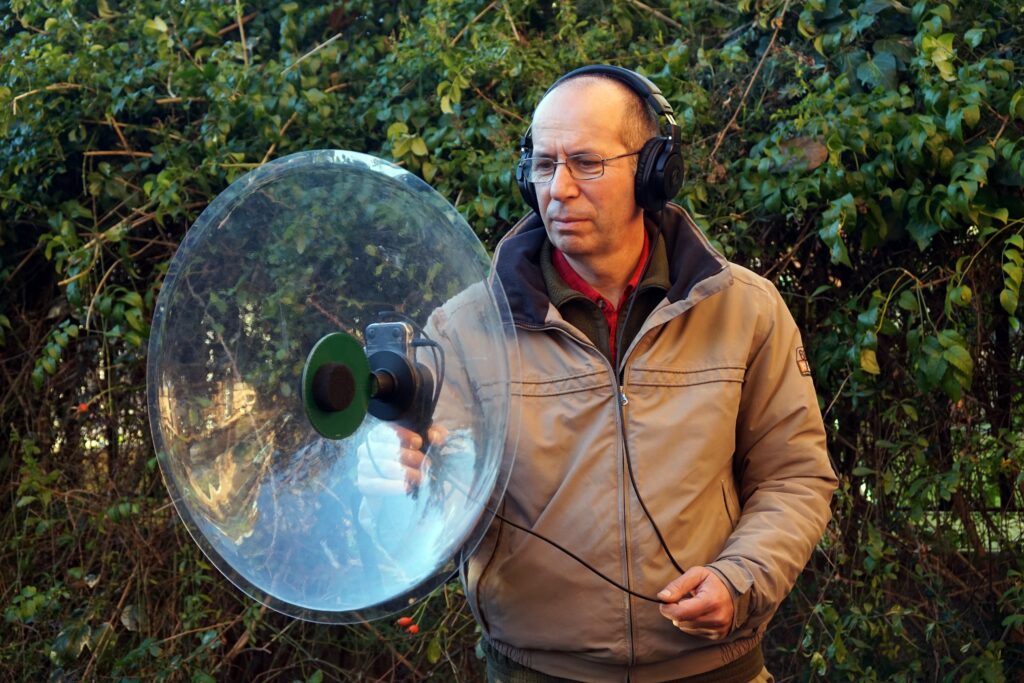
Luca Baghino – at work with a stereo Hi-Sound and a Sony M10 recorder
Luca Baghino, 57 yo, from Genoa, has interest in birds for over forty years, with particular reference to the birds of Liguria, his native region.
He deals with ornithological studies and surveys and is a consultant for public and private entities. He has devoted many years to the study of the raptor migration at the west of Genoa, but also takes part in standardized censuses of breeding birds.
He has collaborated for differents initiatives and projects with the national LIPU (Italian Bird Protection League) since the ‘90s.
Among various scientific publications, he is the author of various ornitholigical papers and coauthored the book “The Short-toed Snake eagle – Biology and migration in the Ligurian Apennines”.
Today we have a chat with him to learn more about his activities in the acoustic field
Luca, can you tell us how you started?
Like many other people, in the second half of the seventies, I began to be interested in bird
sounds as a necessary complement to the visual part, chiefly aimed to the field identification.
Of course at the time (I was a boy …) people traveled with modest cassette recorders and
for training purposes we had available cassettes or vinyl records to learn voices and songs
… another world compared to today in terms of technology. But that was a first knowledge
and was useful, for example, for making surveys such as the Atlas Project of breeding birds
in Liguria.
And more recently?
Well, my activity on the field has continued for years with standardized surveys and projects
on breeding birds such as MITO-FBI and others in Liguria where aural identification always
was essential. But later and now at a mature age, perhaps a random occurrence led to
develop my interest in the fascinating world of animal sounds more deeply than before. In
2013 I had to chance to pick an Eastern Bonelli’s Warbler Phylloscopus orientalis having a
migratory rest in a place that I knew like the back of my hand; the particular contact call of
that bird of a rare and irregular species (I had never seen it before, and later) made me
realize that there was something strange, then I saw and identified it among the tree canopy:
I heard it calling while I was indoors, just to say …
What consequence did this meeting have?
Well, I don’t know if, directly as a result of that report or as an evolution of one of my
“personal paths” since 2015, I have also taken an interest in recording, dedicating myself
also to the detection of night flight calls (the so-called NFC –ed. Night Fight Calls-). Then in
spring-summer, during the bird singing season, whenever possible, I prefer recording with
the use of parabolic mics
Have you had any particular experience in this field?
Yes, as I was saying, I spent years on passive acoustic monitoring after an experimental
technical phase with NFC recording, detection and identification conducted between 2015
and 2019 in the Genoa area; a practice that was rarely, if ever, carried out in Italy at the
time. So, I gained experience and collected data on the acoustic detection of birds during
nocturnal migration by recording the calls they emit in flight. For this purpose, wherever
possible, I used a high-quality stereo parabolic microphone—specifically, with double-PZM
configuration.
I am currently continuing to monitor post-breeding migration of birds using autonomous
recorders equipped with analog MEMS microphones.
What gear do you use?
I have several 96kHz / 24bit recorders: among them, the excellent Sony PCM-M10 was my
favorite for a long time when coupling with the parabolic microphones: it is small and
compact, but it is a little gem. However, I also use the old version Zoom H1 a lot: this has
always fully satisfied me, this being a real workhorse and all round recorder. I also used
other quality pocket recorders such as the Olympus LS-3 and the Tascam DR-05x. I then got
a second-hand Tascam DR-100 mk III, a high -class recorder that I tend to use mostly in
specific situations. My last significant upgrade was to a 32-Bit recorder, the excellent ZoomF3, which features truly remarkable. A few months ago, I bought a secondhand Sound
Devices 302 three-channel mixer to use as a preamplifier, and I added a pocket-sized
external recorder to it; in my opinion, the audio quality is truly stellar. As for the headphones,
I have pairs of Audio-Technica ATH-M30x to M50x, a Shure SRH-440 and the brilliant
Beyerdynamic DT770 closed headphones. For playback and monitoring the AKG K702
(open, over-ear) is my favorite. I have been using Adobe Audition 3.01 as my audio editing
software for years.
What about of the microphones instead?
I have a few dishes of different diameters, 33 and 53cm. The first and most used so far is
the Dodotronic Hi Sound stereo , another workhorse that has given me so much. Over the
years I have expanded the range of parabolic microphones, which includes a mono, a Twin-
mono, and a double PZM from Naturesound. The top model currently is a Naturesound Plug
In Power/XLR 2+2 stereo which is excellent in transparency and soundstage with the Zoom
F3. But the stereo/mono parabolic microphone from Naturesound as well I connect to the
Sound Devices 302 delivers extremely high performance and offers great versatility.
I also used extensively the Primo EM 172s for some DIY applications, both on rigid support
and embedded, also following some previous experiences of yours. The Primo really are
great capsules for naturalistic use and more. I do not use shotgun microphones instead: as I
am so used to the isolation and the amplifying power of the dish, so far I did not get along
very well this kind of mics.
Have you been interested in other aspects of animal recording over the years?
Yes, thanks also to your requests, I delighted in acquiring sounds from other animal groups.
With the help of the excellent Ultramic 384K from Dodotronic I obtained interesting
information and presence data on bats. I also happened to make some recording of
Orthoptera, both in an intentional or “involuntary” way, obtaining a few elements that I think
are intriguing. It is the universe of animal sound and communication that is fascinating for its
complexity, adaptation and variability; also the technical aspects, the exercise and the
practical experience aimed at improving the recording sessions are however essential and
no doubt important.
_____________________________________________________________________
Below are some recordings by Luca Baghino
Turdus philomelos song. Recorded 26.5.2025 – Ronco Scrivia (GE) Italy.
Olympus LS-10 + Naturesound stereo parabola 33cm.
Turdus philomelos song. Recorded 26.5.2025 – Ronco Scrivia (GE) Italy.
Olympus LS-10 + Naturesound stereo parabola 33cm.
__________________________________________________________
Italian version
Luca Baghino 57 anni, di Genova, da oltre quarant’anni si interessa di avifauna con particolare riferimento a quella ligure.
Si occupa di studi e rilevamenti ornitologici ed è consulente per enti pubblici e privati. Ha dedicato molti anni allo studio della migrazione dei rapaci nel Ponente genovese, ma anche ai censimenti dell’avifauna nidificante.
Ha collaborato per varie iniziative e progetti con la LIPU (Lega Italiana Protezione Uccelli) nazionale fin dagli anni Novanta.
E’ autore, tra le diverse pubblicazioni scientifiche, di vari articoli e del libro “Il Biancone – Biologia e migrazione nell’Appennino ligure”.
Oggi facciamo due chiacchiere con lui per conoscerne anche l’attività in campo acustico
Luca, ci racconti come hai iniziato?
Al pari di tanti altri ho cominciato, nella seconda metà degli anni Settanta, ad interessarmi al
mondo delle vocalizzazioni degli uccelli come necessario complemento alla parte
osservativa ai fini dell’identificazione sul campo. Certo all’epoca (ero ragazzo…) si viaggiava
con modesti registratori a cassette e per la parte formativa esistevano musicassette o dischi
vinilici per apprendere voci e canti… un altro mondo rispetto ad oggi in fatto di tecnologie.
Ma fu un primo bagaglio conoscitivo utile, ad esempio, per i primi rilevamenti del Progetto
Atlante degli uccelli nidificanti in Liguria
E in seguito o recentemente?
Beh l’attività sul campo è seguita per anni con i rilevamenti standardizzati per progetti sugli
uccelli nidificanti quali MITO-FBI e altri in Liguria dove il riconoscimento uditivo era
essenziale. Poi però, ormai in età matura, forse un evento casuale mi ha portato a
sviluppare più in profondità l’interesse per l’affascinante mondo delle sonorità animali. Nel
2013 incocciai in un individuo di Luì bianco orientale in sosta migratoria in una località che
conoscevo come le mie tasche e il particolare verso di contatto di quell’individuo di una
specie rara e irregolare (non l’avevo mai vista prima) mi fece realizzare che c’era qualcosa
di strano, individuandolo poi tra la vegetazione: lo sentii mentre mi trovavo al chiuso, per
dire…
Che conseguenza ha avuto questo incontro?
Beh non so se per effetto diretto di quella segnalazione o come evoluzione di un mio
“percorso personale” dal 2015 ho preso anche ad interessarmi alla registrazione
dedicandomi anche all’ambito dei richiami di volo di notte (i cosiddetti NFC –ndr Night Fight
Calls-). In primavera-estate poi, nel pieno della stagione canora degli uccelli, quando
possibile, prediligo la registrazione con uso di parabole.
Hai avuto esperienze particolari in questo campo?
Sì, come dicevo, mi sono dedicato per anni al monitoraggio acustico passivo, dopo una fase
tecnica sperimentale di registrazione, rilevamento e identificazione dei cosiddetti NFC,
condotta tra il 2015 e il 2019 nell’area di Genova, un’attività poco o per nulla praticata in
Italia in quegli anni. In particolare, ho acquisito esperienze e raccolto dati sul rilevamento
acustico degli uccelli durante la migrazione notturna mediante la registrazione acustica dei
richiami emessi in volo. Ho utilizzato a tal fine, laddove era possibile, un microfono
parabolico stereo di qualità, con una configurazione doppio-PZM. Sto tuttora seguendo la
migrazione post-riproduttiva usando registratori autonomi con microfoni analogici MEMS.
Che attrezzature usi abitualmente?
Ho diversi recorder 96kHz/24bit tra i quali il mio preferito per l’accoppiamento con i microfoni
parabolici è stato a lungo l’eccellente Sony PCM-M10: è piccolo e compatto, ma è un
gioiellino. Uso però molto anche lo Zoom H1 vecchia versione che mi ha sempre
pienamente soddisfatto, un vero cavallo di battaglia, per tutte le situazioni in cui serve. Ho
usato, tra i registratori tascabili, anche l’ottimo Olympus LS-3 e il Tascam DR-05x. Ho
successivamente preso un Tascam DR-100 MK III d’occasione, un prodotto di classe molto
elevata che punto ad utilizzare in particolari situazioni. Un ulteriore miglioramento c’è stato
passando ad un registratore 32-bit, l’eccellente Zoom F3, che ha una qualità sonora davvero
notevole.
Ho preso alcuni mesi fa un mixer Sound Devices 302 a tre canali usato come
preamplificatore a cui ho aggiunto un registratore esterno tascabile: la qualità audio che si
ottiene è inarrivabile secondo me.
Per le cuffie uso un paio di cuffie chiuse Audio-Technica ATH-M30x e M40x, le Shure SRH-440 e le superlative Beyerdynamic DT770; per il riascolto prolungato e il monitoraggio mi
trovo molto bene con le AKG K702, un modello aperto over-ear. Uso poi da anni Adobe
Audition 3.01 come software di editing audio.
Sul fronte dei microfoni invece?
Ho diverse parabole, di differente diametro, per ora tutte stereo. La prima e la più usata
finora è la Dodotronic Hi Sound stereo, altro cavallo di battaglia che mi ha dato tanto.
Negli anni ho ampliato significativamente la gamma dei microfoni parabolici, che include una
mono, una Twin-mono, e una doppio PZM della Naturesound. Il modello top per me è
attualmente una Naturesound Plug In Power/XLR 2+2 stereo che è eccellente in fatto di
trasparenza e scena sonora con lo Zoom F3. La soluzione di un microfono parabolico
stereo+mono della Naturesound che collego al Sound Devices 302 è davvero di qualità
estremamente alta e offre grande versatilità d’uso.
Ho anche ampiamente utilizzato le Primo EM 172 per alcune realizzazioni DIY, sia su
supporto rigido, sia libere ma incastonate, seguendo anche le tue precedenti esperienze. Le
Primo sono capsule davvero eccellenti per l’uso naturalistico e non solo. Non adopero
invece microfoni tipo shotgun: abituato alla capacità di isolamento e amplificazione della
parabola, finora non mi sono trovato molto bene con questo tipo di strumenti.
Ti sei interessato ad altri aspetti della registrazione animale negli anni?
Si, anche grazie ai tuoi stimoli, mi sono dilettato ad acquisire suoni di altri gruppi animali.
Con l’aiuto dell’eccellente Ultramic 384K della Dodotronic ho ottenuto informazioni e dati di
presenza anche interessanti sui Chirotteri. Mi è capitato di fare qualcosa anche con gli
Ortotteri, in forma intenzionale o “involontaria” ottenendo anche qui alcuni elementi secondo
me interessanti. È il mondo della comunicazione sonora degli animali ad essere affascinante
per la sua complessità, per gli adattamenti e le variabilità; anche l’aspetto tecnico, l’esercizio
e l’esperienza pratica volte a migliorare le sessioni di registrazione sono però imprescindibili
e chiaramente importanti.
Commenti recenti